The Sound of Sabotage
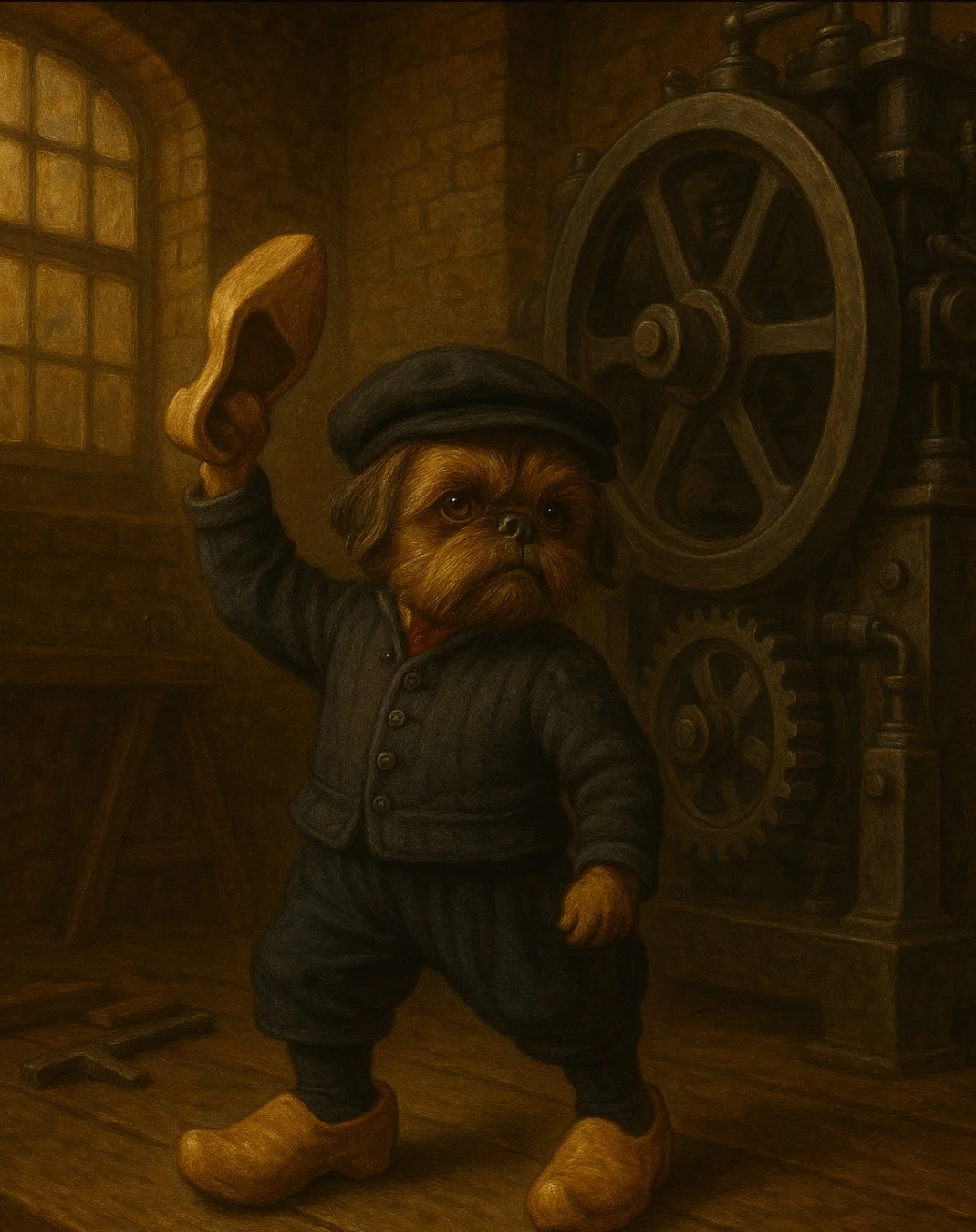
Dear Chewey,
Everywhere I turn in Amsterdam, there’s a reminder of how this city once built the world on trade, ingenuity, and a refusal to sit still. Yet one of its most enduring icons, the simple wooden shoe, is tied to a word that means the exact opposite: sabotage.
The story goes that during the early days of industrialization, French workers, frightened by the machines threatening to replace their jobs, hurled their wooden shoes, known as “sabots”, into the gears to stop production. Whether that actually happened hardly matters anymore; the symbolism was too good to ignore. Those clogs became a protest, a declaration of power from the powerless. And so the word sabotage was born, from the clatter of wooden soles and the fear of progress.
It wasn’t an isolated act of rebellion. Across the Channel, the Luddites were taking hammers to textile looms, fighting to preserve a way of life they saw slipping through their calloused fingers. It was a war between human craftsmanship and mechanized precision, fought not with bullets, but with tools and defiance.
If this history sounds familiar, it’s because it is discussed at horrifying length during a critical scene in Stephen King’s Misery, and if you’ve seen the film, you probably just winced. Annie Wilkes, the obsessed fan of Paul Sheldon’s, “hobbles” her captive author by smashing his ankles, all while explaining that the etymology of sabotage, originating from those same clunky wooden shoes. The moment is cringeworthy, but her point, twisted as it is, lands: sometimes the damage comes from those who think they’re protecting something.
As I found myself walking these same cobblestone streets this past week, during the Amsterdam Dance Event (ADE), which is a global celebration of electronic music, it became apparent that the descendants of those early machines are now instruments of joy. Beats built from circuits, melodies born in code. What the Luddites once destroyed, DJs now worship.
And somewhere between the kick drum and the canal reflections, I recognized a quieter, more personal kind of sabotage.
Mine.
Speaking of Misery, I was in my own version of it when I first arrived here. The houseboat I rented for the week turned out to be a catfishing masterpiece: a bait-and-switch straight from the dark web of Airbnb photography. The listing promised sunlight, space, and serenity; the reality delivered a water crane outside my window, fully obstructing a beautiful view of the Amstel canal, an upstairs neighbor practically in my lap, and an interior that refused to get warm no matter how high I turned the heat up in my cracker box of a rain shelter.
Initially, the locals didn’t exactly thaw me out either. When I asked a shopkeeper where the nearest grocery store was, he looked at me as though I’d just asked how to breathe and said, “Use Google,” like it was a brand-new invention. Then, at the store, after asking for a bag before checkout, the cashier chided me: “In Holland, we pay for bags.” His tone suggested I’d just stumbled out of the 1950s, fresh from a land where Americans get everything for free. I wanted to tell him I was just trying to pay for it efficiently, but by then, the transaction, along with my patience, were both over.
It was one of those travel days where everything conspires to test your optimism. The city that everyone told you would charm you just leaves you cold, literally and figuratively. And the more I stewed about it, the clearer it became that I was throwing my own sabots into the experience. I could blame the weather, the houseboat, the clerk, the crane, but really it was me resisting what was, clinging to what I thought should be.
After a day of self-indulgence, it occurred to me what I had been doing to my own personal “machinery”, not with hammers or sabots, but with hesitation. With overthinking. Frustration. With self-doubt dressed up as pragmatism. And so I did what any normal person does in these moments, and began to conduct a personal inventory.
And here’s the irony: as I stand surrounded by music born from machines, I used another machine, ChatGPT, to help me define my own mission, vision, and values. A Luddite and a futurist in the same breath. The ghost of a factory worker in wooden clogs and the pulse of a synthesizer somehow co-existing in one body.
Maybe that’s the lesson Amsterdam is whispering through its narrow alleys and neon lights:
Progress isn’t the enemy.
The machine isn’t out to get us.
It’s just waiting for us to stop throwing things in its gears.
So as the night’s of Amsterdam’s beautiful city hummed with electronic sound, and as I began to sip something Dutch and deliberate, I chose not to sabotage. Not to hobble. Not to fear the rhythm.
Instead, I’ll learned to dance with it.
Love,
Dad